This article has been reviewed according to Science X’s
editorial process
andpolicies.
Editorshave highlighted
the following attributes while ensuring the content’s credibility:
fact-checked
peer-reviewed publication
trusted source
proofread
A three-month Fulbright U.S. Scholar trip to Argentina wasn’t just about bringing Texas know-how to South America for Gabriel Hamer, Ph.D., a Texas A&M AgriLife Research entomologist and professor in the Department of Entomology in the Texas A&M College of Agriculture and Life Sciences.
His time in Argentina was spent learning from scientists who have been fighting Chagas disease far longer than he has.
Hamer’s research and teaching at AgriLife Research broadly investigate the ecology and control of vector-borne infectious diseases in humans, wild animals and domestic animals. He has studied vector-host interactions that lead to parasite amplification and increased disease risk. He also develops and evaluates vector control approaches aimed at reducing human and animal disease.
Gaining deeper insight
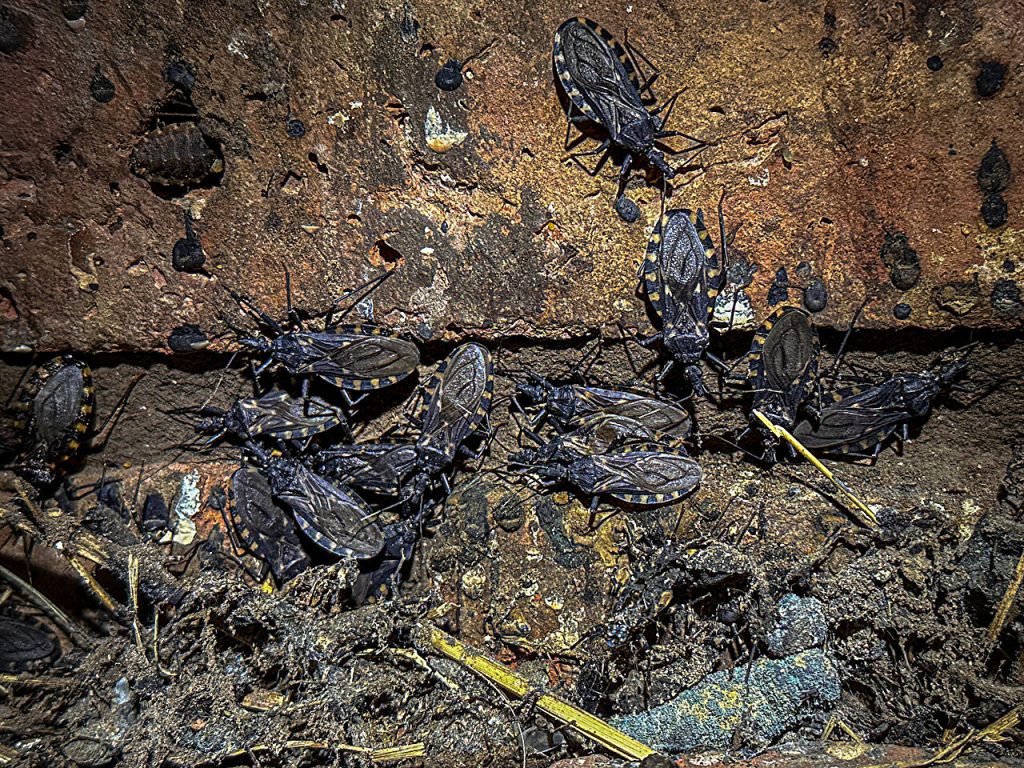
Hamer spent the spring with the research team in the Eco-Epidemiology Laboratory at the University of Buenos Aires. These scientists have spent multiple decades studying Chagas disease and its insect vectors, triatomines, known as “kissing bugs” in the U.S. and “vinchucas” in Argentina.
The trip opens the door to expanding U.S. scientific understanding of Chagas disease. Hamer was among researchers who contributed to a multi-institutional perspective article urging public health acknowledgment thatChagas is endemic in the U.S.and poses a threat to human and companion animal health.
Continued research in South America and by U.S.-based scientists is important because some disease-carryingtriatomines have developed resistance to insecticides.
“The vast majority of the research on these vectors and the parasite has been done in Latin America,” Hamer said. “In a lot of ways, we in the U.S. are just catching up. It benefits us to gain experience and build collaborations with people in places like Argentina.”
Bilateral learning, better data
That exchange runs both ways, Hamer said, describing the concept as “bilateral learning.” It was an opportunity to build new relationships, share expertise and lay the groundwork for research that propels mutually beneficial discoveries.

His Argentine colleague, Victoria Cardinal, Ph.D., is now under review to join Texas A&M’s graduate faculty so she can serve on graduate student committees. Timara Vereen, Hamer’s doctoral student in the Ecology and Evolutionary Biology Program, spent a month with Hamer at the Eco-Epidemiology Lab in Argentina’s Chaco province.
Hamer deployed solar-powered kissing bug traps he has spent the past six years developing. Unlike mosquitoes, ticks and other vectors, kissing bugs have been notoriously hard to trap, making their surveillance difficult. Arecent studypublished inPLOS Neglected Tropical Diseasesdocuments the trap’s success in Texas, Mexico and Guatemala.
The trap performed in ways that exceeded expectations. There were questions about whether the trap would work on Triatoma infestans, the South American species most responsible for human Chagas cases, because it readily colonizes human homes.
The trap not only captured T. infestans, but also several additional species of kissing bugs, including species rarely documented around homes in the region but that can play a role in disease transmission.
“That’s valuable,” Hamer said. “It shows this is a tool with broad applicability to pretty much all triatomine species in the Americas, but it also showed a capability of providing specimens that were rarely captured by previous methods. That is invaluable to research and understanding these insects and how they move across the landscape and spread the parasite that causes Chagas disease.”
From specimens to collaborative solutions
The specimens collected are already generating new data. With lab work in both Argentina and Texas, Hamer’s team is analyzing the insects to identify which animals they fed on, whether they carried the parasite that causes Chagas disease, and their genetic origin through molecular testing.

The goal, Hamer said, is to answer a long-standing question in vector biology: how far these insects disperse and how they transition from natural habitats to domestic settings, ultimately feeding on humans and domestic animals.
Dogs play a critical role as parasite reservoirs in Latin America, and studies are underway in Texas to protect dogs from infection, which can lead to heart disease or death.
Beyond surveillance, Hamer said the trap may eventually work as a control tool. He and collaborators are exploring whether clusters of traps placed around homes or dog kennels could intercept dispersing adults before they reach people or pets-similar to mass-trapping strategies already used against mosquitoes.
Hamer hopes the visit can build toward future funded research.
For the Department of Entomology, the trip reflects a broader priority: training the next generation of scientists like Vereen through international, cross-institutional collaboration on vector-borne diseases. The trip provided hands-on experience beyond the lab. The expedition allowed her to work alongside experienced Argentine students and researchers and to see how vector surveillance can impact communities.
It is work that Hamer said starts abroad but circles back to protecting public health in the U.S.
“These types of collaborative projects are an investment,” Hamer said. “It takes years to cultivate these partnerships, but they eventually pay off in a number of ways.”

Publication details
Yuexun Tian et al, Advancing the design of the kissing bug kill trap for surveillance of triatomines,PLOS Neglected Tropical Diseases(2026).DOI: 10.1371/journal.pntd.0014005
Journal information:
PLoS Neglected Tropical Diseases
Key concepts
disease vectorscapturing (animals)dispersal (organisms)pest controlcarnivoresHost-Parasite Interactions
Provided by
Texas A&M University
BSc Life Sciences & Ecology. Microbiology lab background with pharmaceutical news experience in oil, gas, and renewable industries.
Full profile →
Master’s in physics with research experience. Long-time science news enthusiast. Plays key role in Science X’s editorial success.
Full profile →
Scholar’s work in South America helps fight Chagas disease in the U.S. (2026, August 14)
retrieved 14 August 2026
from https://phys.org/news/2026-08-scholar-south-america-chagas-disease.html
part may be reproduced without the written permission. The content is provided for information purposes only.
Kaynak: Sciencex