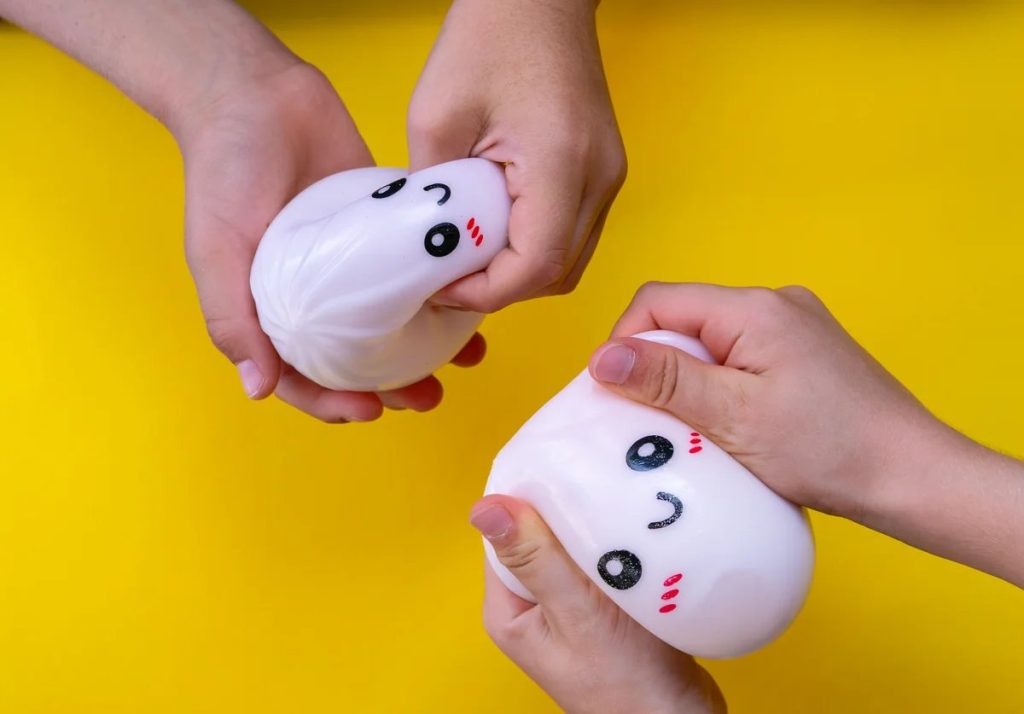
Squishies are essentially next-generation stress balls, marketed as a tactile tool to boost concentration and relieve stress. They’re popular among children, but adults seeking a satisfying squeeze have started collecting them, too. On social media, product reviews, along with videos of proud squishy owners ranking their collections and parents poking fun at their kids’ obsessions, have generatedmillionsofviews.
But what makes squishiessoflexible, springy and just, well, squishable? And are they safe? The answer is surprisingly complicated.
For parents, information can be sparse: “There’s no requirement for these toy companies to tell us what’s in any of these products,” says Deborah Bennett, a professor and exposure scientist at the University of California, Davis.
Toy company Schylling, which makes the popular squishy brand NeeDoh, says on itswebsitethat its NeeDoh products are made of thermoplastic rubber and may be filled withpolyvinyl alcohol(PVA) or maltose, a type of sugar, and, in some cases, water-soluble dye. Filling materials are disclosed on individual packaging, and NeeDoh products are tested by third-party laboratories, Schylling tellsScientific Americanin a statement. Thewebsitefor Tabasquishy, another popular brand, says that its squishy products are made of “100% solid food grade silicone,” a material “used for baby pacifiers and high-quality kitchenware.”
These materials are intended to squish-thermoplastic rubber and silicone are designed to be soft and pliable but bounce back to their original shape. Polyvinyl alcohol is a polymer you might find in, say,dishwasher detergent podsor in coatings onpills or supplements.
As for other squishies, it’s hard to say. Without sending them off to a lab for analysis, we just don’t know what’s in the various unbranded bao, gummy bears, and more on offer at retailers and fun fairs everywhere.
When it comes to safety, what’snotincluded on ingredient lists is often the problem: In May, for instance, the U.S. Consumer Product Safety Commission (CPSC), the primary body responsible for regulating toy safety, issued arecallfor more than 120,000 units of “Funkee Monkee” squishy toys from the company Orb because of potential asbestos contamination. And in June the U.K.’s Office for Product Safety and Standardsrecalled“Squeezy Dumplings” linked to a Welsh wholesaler because of an “excess concentration of benzene,” at 20 milligrams per kilogram. (When reached for comment, the wholesaler, Samsons Cash & Carry, said that it was a “stockist and supplier” of the product and not the importer or distributor.)
“You don’t want to have benzene in children’s toys because it’s a known human carcinogen,” Bennett says. It can also cause skin and eye irritation,among other issues. “There’s no reason it should be in children’s toys,” she says.
Similar dumpling-shaped products in the U.S. have not been recalled at this time. “We’re aware of these recalls but cannot comment on any investigations or cases before the CPSC,” acting CPSC chairman Peter Feldman said in a statement toScientific American.
Around the same time as the U.K.’s Squeezy Dumplings recall, aninvestigationby theToronto Stardetected low levels of volatile organic compounds, or VOCs, in a selection of dumpling squishy toys. It’s unclear exactly how dangerous exposure to these chemicals is at very low levels, chemists told theStar. But at least one compound, vinyl chloride, found in a rainbow dumpling squishy made by Really Magical Stuff (RMS), isn’t considered safe at any level.
Vinyl chlorideis a solvent that can get into children’s toys during the manufacturing process, Bennett explains, and, like benzene, is known to be cancerous.
“There is no reason we should be using solvents that are known human carcinogens in the manufacture of children’s toys,” she says. “There’s lots of other solvents that are safer.”
According to the CPSC’s Feldman, “all children’s products with hazardous substances are banned” under U.S. law. And children’s toys arerequired to undergothird party testing. Some dangerous products are stopped before they enter the market-to date, the CPSC has identified 55 squishy toy shipments in violation of safety standards and prevented 355,683 units from reaching consumers, the commissionstatedin a warning notice issued last week.
But research shows contaminated toys are stillslipping through the cracks. Toy testing standards do exist-ASTM International publishes guidelines for hazardous chemicals such as lead and phthalates-but “something is missing,” says Jorge Gardea-Torresdey, an environmental chemist at the University of Texas at El Paso.
He notes that other countries, such as those in the European Union, have stricter rules on chemical pollutants. Last month Gardea-Torresdey and his colleagues published a study in the journalEnvironmental Pollutionshowing that78 percent of children’s toyscollected from shopping centers near the U.S.-Mexico border contained some kind of potentially hazardous element, such as zinc, nickel or lead.
According to the CPSC notice, to limit the chances of dangerous exposure, the agency recommends avoiding “fake and counterfeit” squishy toys, which are often sold without listing the manufacturer, age grading or safety warnings. It also recommends to stop using any toy that has “a strong chemical odor, feels oily or unusually sticky, is leaking, or can be torn apart easily.”
And please don’t put squishies in the microwave. “Videos shared online may depict the toys expanding, changing texture, or bursting when heated,” the CPSC said. “These demonstrations are dangerous and should never be attempted or imitated.”
Several companies and vendors contacted byScientific Americanfor this article, including Tabasquishy, A&A Global, Top Trenz and Squeezy (not affiliated with the Squeezy Dumplings recall), did not immediately respond to a request for information about their products. Orb and RMS didn’t respond to a request about possible contamination of their products. We’ll update this article if we hear back.
Kaynak: Instagram