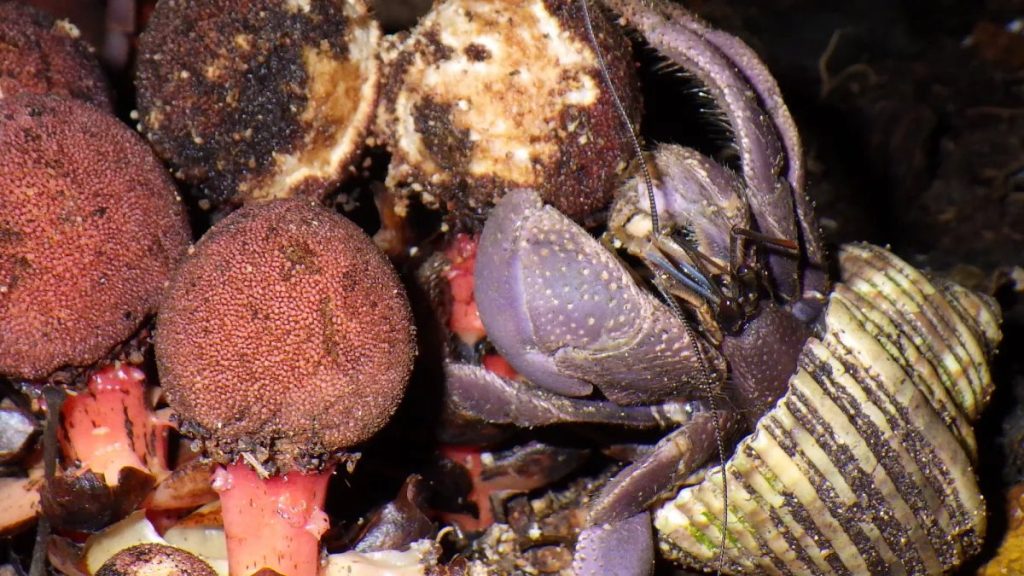
Hikers exploring the coastal forest on a tropical island near Okinawa, Japan, would be forgiven for thinking thatBalanophora fungosais a simplemushroom. They have dark caps and grow along the forest floor, but these are no harmlessfungi-they’re parasitic plants that get their nutrients from the roots of nearby plants. Eachyeasty-smelling B. fungosaproduces up to one million tiny seeds covered in a dry fruit, but scientists had no idea how these seeds were dispersed.
“Many people assumed that they simply fall by gravity and are carried away by the wind, but the humid and windless forest floor makes this seem rather implausible,”explainedKobe University botanistSuetsugu Kenji.
Suetsugu’s earlier research found that ants, crickets, and cockroaches can disperse the plant’s fruits, but there were some caveats. Only the fruits that were firmly attached to the plants were visited by insects with strong mandibles, while the easily detachable fruits were visited by smaller invertebrates. He suspected that ants would be the main disperser, since has dull colors, a yeasty smell, and easily detachable fruits for ants.
However, when Suetsugu covered the plants with nets that allow ants to pass through but not larger animals, he noticed that the fruits were not picked up. He set up a time-lapse camera, hoping to catch a disperser in the act. And he did.
To his surprise, the main disperser is a landhermit crabnamed According to his new study published today in the journalEcology, the crabs scraped off the fruits with their pincers, and could even remove an entire plant’s fruit overnight. Some of the tiny seeds within the fruit also survive passage through the crabs’ digestive tract. These crabs can travel up to 328 feet (100 meters), and are likely spreading these seeds far and wide through their poop.
“I was excited to find this because these animals have usually been regarded as omnivores, scavengers or seed predators rather than potential plant partners,” said Suetsugu.
“I was excited to find this because these animals have usually been regarded as omnivores, scavengers or seed predators rather than potential plant partners,” said Suetsugu.
Suetsugu also found that the hermit crabs appear to actively seek out the mature plants, since they were not spotted around immature plants. This indicates that the crustaceans were probably attracted by the mature plants’ scent. That yeasty aroma is likely a direct advertisement to the local invertebrates, who feed on almost anything they can snatch up with their pincers.
“When it comes to seed dispersal, large vertebrates have received most of the attention, but small-bodied invertebrates are often overlooked,” Suetsugu explained. “Nevertheless, they may also help maintain seed movement, especially on islands, in fragmented habitats, and on shaded forest floors.”
“When it comes to seed dispersal, large vertebrates have received most of the attention, but small-bodied invertebrates are often overlooked,” Suetsugu explained. “Nevertheless, they may also help maintain seed movement, especially on islands, in fragmented habitats, and on shaded forest floors.”
Kaynak: Popular Science