

This article has been reviewed in accordance with Science X’s editorial process and policies. The editors have highlighted the following features while ensuring the reliability of the content:
Reality-checked

Peer-reviewed publication
reliable source
Proofread for spelling and language
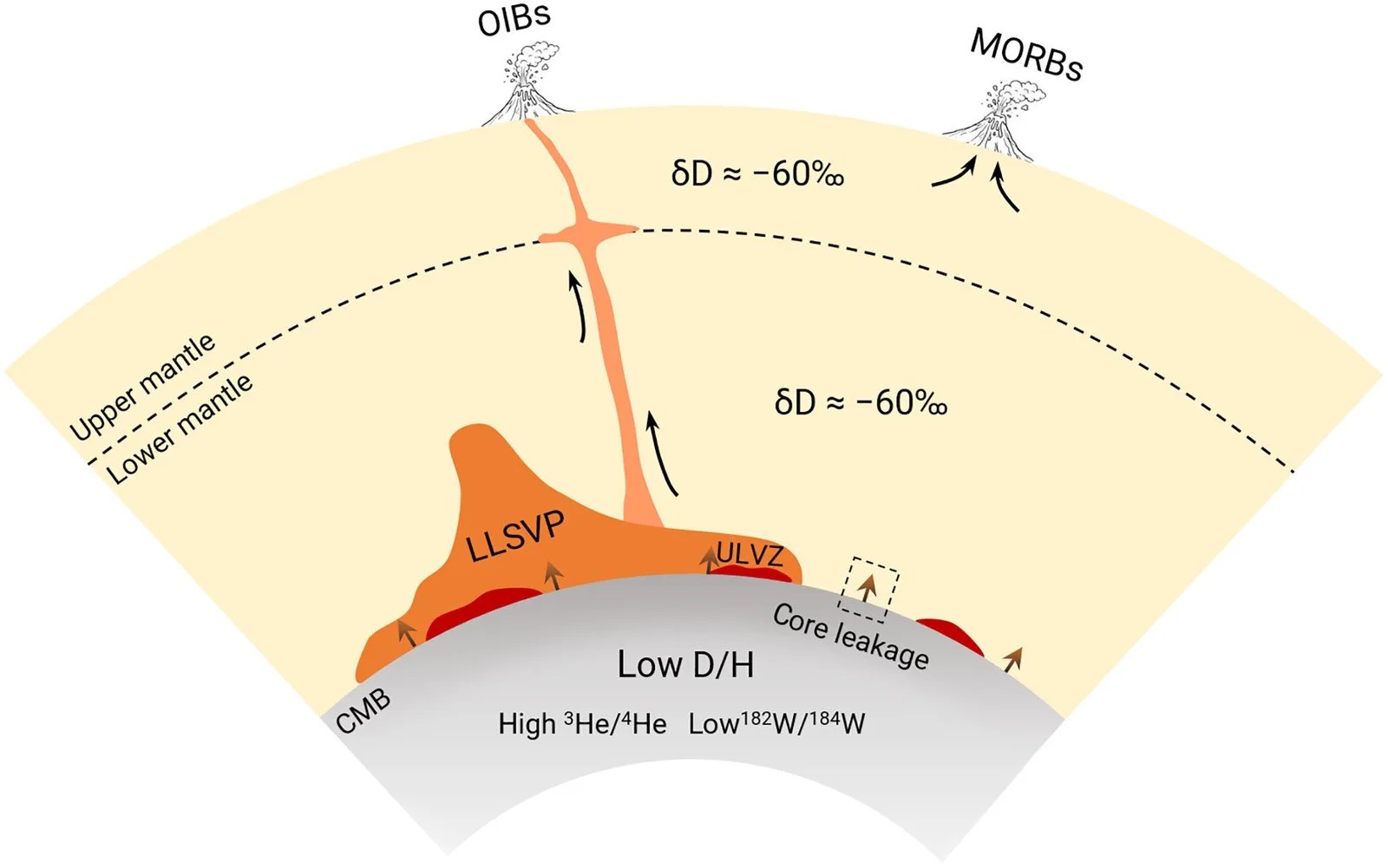
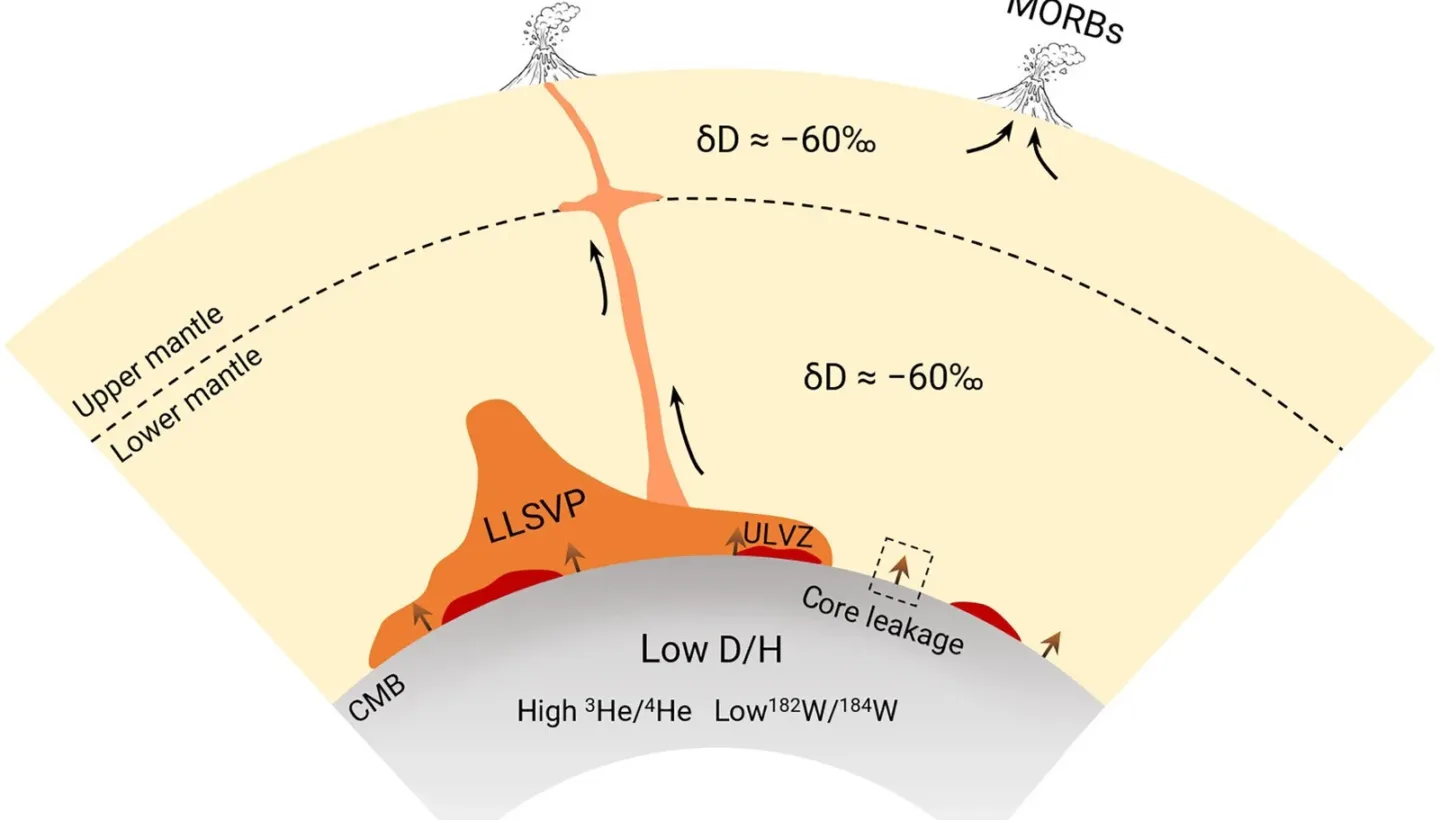
Schematic model showing the origin of isotopic anomalies in oceanic island basalts. Source: Science Advances (2026). DOI: 10.1126/sciadv.aei4756
When the Earth formed billions of years ago, its metallic core was surrounded by a global magma ocean composed of molten rock; this ocean eventually cooled and crystallized to form the mantle. Today, when mantle plumes with deep roots rise toward the surface and trigger volcanic eruptions, the resulting lavas may contain hydrogen from the planet’s deep interior.
Hydrogen exists in two stable forms: the standard light hydrogen and a heavier form called deuterium. While most volcanic rocks have relatively normal hydrogen isotope ratios, some lavas associated with deep mantle plumes contain unusually low amounts of deuterium.
This rare mixture sparked a major debate: Did this low deuterium signature form as the magma ocean froze in the early period, or is it sourced from hydrogen seeping out of Earth’s metallic core?
Journey to the Earth’s Molten Phase
A research team led by Wenzhong Wang at the University of Science and Technology of China has used advanced computer simulations to recreate conditions thousands of kilometers deep beneath the Earth’s surface.
The team examined how the two forms of hydrogen behaved as molten rock cooled and crystallized into different minerals. They then used their results to model how the two forms of hydrogen were distributed in Earth’s early mantle.
The article published in the journal Science Advances states that researchers have found that two forms of hydrogen are distributed relatively evenly in the mantle as ancient magma cools and crystallizes. Although there are small differences in ratios at different depths, there was no situation similar to the unusually low deuterium levels found in volcanic rocks in places like Baffin Island in the North Pole of Canada and Iceland.
“Our results indicate that crystallization of the magma ocean does not lead to significant fractionation of hydrogen isotopes in Earth’s mantle,” say the study’s authors.
The Leaking Core Theory
This means that the freezing of the magma ocean cannot explain these unusual signatures. Therefore, researchers support the explanation of leakage from the core. They argue that hydrogen with a low deuterium ratio could have leaked from Earth’s metallic core into the surrounding mantle over billions of years.
There’s another clue pointing to the core. Some of these volcanic rocks also have an unusually high helium-3/helium-4 ratio. Helium-3 is a rare form of helium that may have been preserved in Earth’s core for billions of years.
While the findings strengthen the hypothesis of hydrogen leaking from the core, it has not yet been fully clarified how the material actually reached the mantle.
Elucidating the mechanisms that enable the transfer of seed signatures to the mantle remains an important objective for future studies.
This article was written for Science X by Paul Arnold; edited by Lisa Lock, with Robert Egan handling the fact-checking and review. The article is the product of careful human effort. Science X relies on the support of its readers to maintain independent science journalism. If this news matters to you, please consider making a donation (especially a monthly contribution). As a thank you, you’ll gain an ad-free account.
Yu Zhang and colleagues, “Hydrogen isotopes reveal water leakage from the core,” Science Advances (2026). DOI: 10.1126/sciadv.aei4756
She earned a bachelor’s degree in biology from the University of London. She is a BBC documentary producer with experience traveling the world. She works remotely from southern Spain. Full profile →
She holds a bachelor’s degree in art history and a master’s degree in material culture. She is a former museum editor, paramedic, and organ transplant coordinator. She has been doing editing for Science X since 2021. Full profile →
She holds a bachelor’s degree in mathematical biology and a master’s degree in creative writing. She has a unique perspective on science and language, and is a well-traveled person.
© 2026 Science X Network
Feedback to Editors
Bu gelişme hakkında düşüncelerinizi, donanım deneyimlerinizi veya sorularınızı Community Forumumuzda paylaşın.
Foruma Katıl & Yanıtla ➔






















첫 번째 댓글을 남겨보세요
출처, 질문 또는 건설적인 반론으로 의견을 발전시켜 보세요.