
There’s a lot going on beneath our feet, geologically speaking: layer upon layer of shifting rock, metal, and chemicals, and because getting a direct look inside Earthis so difficult, scientists rely on a range of smart inferences to figure out what lies beneath us.
Every so often, there’s a real surprise, and the discovery of something we didn’t know about before – as is the case with a new study published in theJournal of Geophysical Research: Solid Earth, analyzing the magnitude 4.8 earthquake that hit Tewksbury, New Jersey, in April 2024.
The obvious suspect for the quake was theRamapo Fault, stretching across the northeast and mid-Atlantic region for almost 300 kilometers (186.4 miles).
The only problem?
It’s not really angled in the right way to have triggered the Tewksbury earthquake.
That led a team from Columbia University in the US to take a closer look. By crunching data on the area’s topography, aftershock locations, and lab friction tests, the researchers think there’s another fault that we never knew about.
“The 2024 Mw4.8 Tewksbury, New Jersey earthquake occurred near the ∼300-km long Ramapo Fault, which, although constituting the largest regional fault, is misoriented for slip in the current tectonic stress regime,”writethe researchers in their published paper.
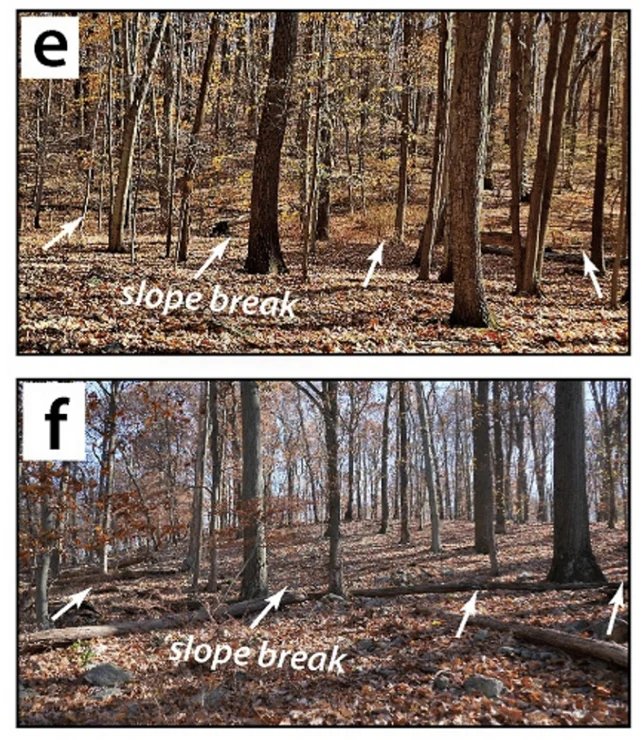
“The upward projection of aftershocks aligns with the topographic (LiDAR) trace of a previously unmapped fault zone 3.5 kilometers west of the epicenter.”
Named the Mountainville Fault by the research team, they classify it as an ‘immature’ basement-hosted fault: one in old crystalline bedrock with fractures that have not yet merged into a single, well-developed main slip surface.
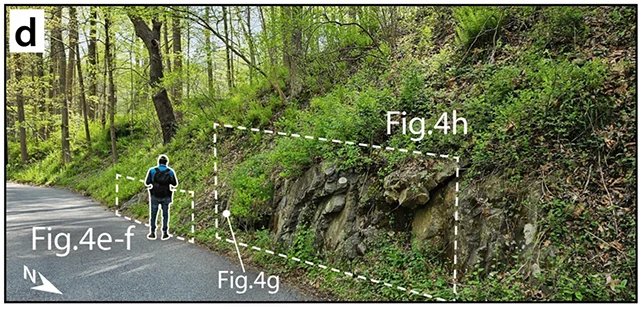
To determine that the Mountainville Fault was there, the researchers looked at 3D seismic wave data from earthquake aftershocks to identify the location of its source. This was combined withLiDAR scansof the area to look for surface ridges hidden by vegetation, and by walking the line of the fault to identify telltale fault signs exposed above ground.
Further tests in the lab modeled the shape, pressure, and composition of the Mountainville Fault, to ascertain that it could indeed behave in the way seen with the New Jersey earthquake.
“These structural characteristics fit previously investigated earthquake sources in the region, suggesting that immature basement faults may constitute important seismic hazards in intraplate settings than previously thought,”writethe researchers.
However, while the earthquake detailed in the field recordings is a good fit for the modeling done in the lab, it’s not an exact match. The researchers think that there was an additional nudge involved, something like a changein water pressureor the removal of rocks in a crucial area.
“We speculate that a local shallow stress perturbation may have triggered the shallow mainshock event,”writesthe team.
“The heterogeneous composition of the Mountainville Fault rocks may have further compounded frictional instability during fault failure by redistributing normal stresses and concentrating them preferentially on quartz‐rich patches.”
One of the interpretations that the teamputs forwardis that “the misorientation of the Ramapo Fault to frictional failure” mayconcentrate stressin the surrounding crust rather than release it along the large fault itself. That could make nearby, less prominent faults more likely to fail.

The researchers suggest these smaller, lesser-known (or completely unknown) faults need to be investigated further, which is the plan for the Mountainville Fault – now that we know it’s there.
“We propose that in the highly populated US east coast, seismically unstable, immature, structurally complex faults similar to the Mountainville Fault may constitute important earthquake sources and thus, pose previously unrecognized but critical earthquake hazards,”writethe researchers.
The research has been published in theJournal of Geophysical Research: Solid Earth.
This article was fact-checked byRebecca Dyerand edited byRebecca Dyer. While we pride ourselves on our process, we are only human. If you spot a mistake, [[LINK_15: please let us know]].
Kaynak: En


