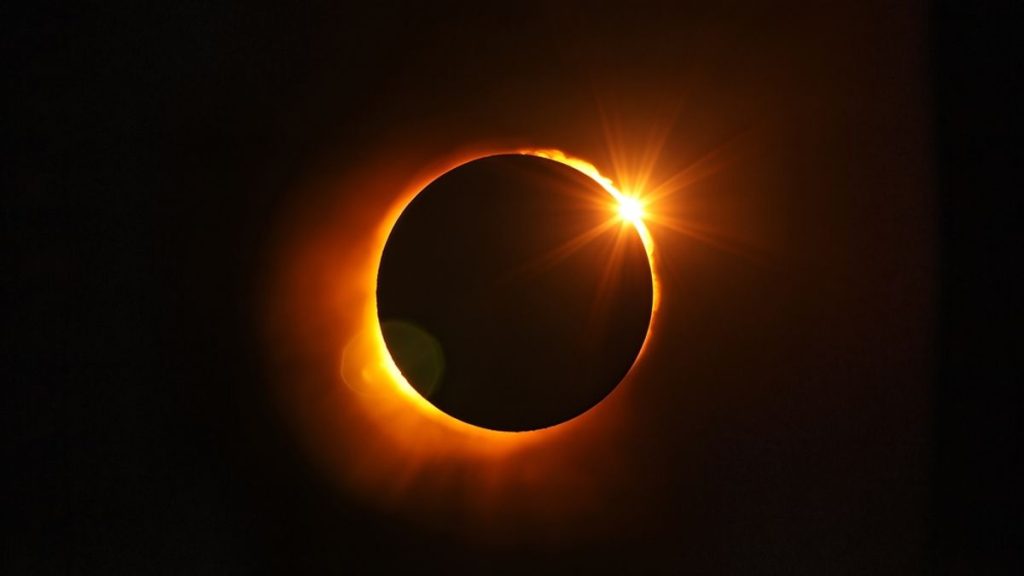
The Moon will pass between Earth and the Sun today, completely covering the Sun along a path through northern Russia, Greenland, Iceland, northern Spain, and a small part of Portugal. Most of Canada, parts of the northern U.S., much of Europe, and northwestern Africa will see a partial solar eclipse.
Along the path of totality, the Moon will cover the entire solar disk for up to two minutes and 18 seconds. This will be the first total solar eclipse visible from central or western Europe since 1999, according to the observatory.
Today’s eclipse occurs as the Moon moves in front of the Sun from our view on Earth. People within the path of totality will see the Moon cover the whole Sun, while those outside that path will see only part of it covered.

At totality, the Moon hides the Sun’s visible surface, revealing its outer atmosphere, called the corona. Daylight fades briefly before returning as the Moon continues moving. According to the National Solar Observatory, a total eclipse passes over the same place about once every 400 years on average.
The Royal Observatory Greenwich will show a partial eclipse from London today. As the Moon covers more of the Sun, the remaining visible portion will take the shape of a crescent. At the peak, about 90 percent of the Sun will be covered, enough to change the light and temperature without making the sky fully dark.
The Moon has reached the edge of the Sun over London, marking the beginning of the partial solar eclipse. A small section of the solar disk is now covered. The Moon will continue moving across the Sun for nearly an hour before the eclipse reaches its peak.
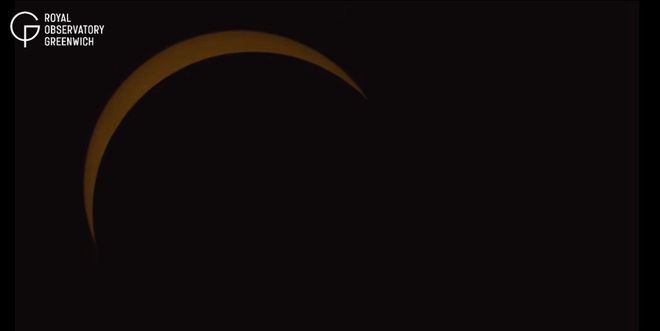
The partial eclipse has reached its maximum. During the past hour, the Moon has covered more and more of the solar disk, leaving the visible Sun as a narrow crescent.
Maximum marks the point when coverage stops increasing, not a change in the Moon’s direction. As the Moon continues along its path, it will begin uncovering the Sun, and the crescent will widen until the full disk returns to view.
The eclipse is nearing its end. Since maximum, the narrow crescent has widened as the Moon has moved toward the far edge of the Sun. The solar disk is now almost fully visible again, with the eclipse expected to end at about 2:06 p.m. CT.
Today’s eclipse is ending, but the next one is less than a year away. On Aug. 2, 2027, the Moon’s shadow will cross southern Spain and North Africa before continuing into Saudi Arabia and Yemen. Near Luxor, Egypt, totality will last about six minutes and 23 seconds, nearly three times as long as the longest totality seen today, according to NASA. Eastern Canada and northern Maine will also see part of the eclipse, though they will remain outside the path of totality.
Article Sources
Our writers atDiscovermagazine.comuse peer-reviewed studies and high-quality sources for our articles, and our editors review for scientific accuracy and editorial standards. Review the sources used below for this article:
- This article references information from the Royal Observatory Greenwich
- This article references information from the National Solar Observatory
- This article references information from NASA
Kaynak: Discovermagazine