Give a tiny flatworm plenty of food, and its solitary body rapidly lengthens as new heads emerge one after another.
Within days, a single worm becomes a chain of four or five connected clones, tethered together temporarily.
Yet this transformation does not result from a new genetic mutation. It occurs when the worm’s ordinary reproductive cycles overlap.
Essentially, the worm gets ahead of itself in a food frenzy, starting to grow the next clone before the last one it made has detached.
Scientists at the University of Warsaw in Poland discovered that abundant food can trigger this striking transformation in four microscopicflatworm species, which live mainly in freshwater.
The study isavailable as a bioRxiv preprintand has not yet been peer-reviewed.
Flatworms are soft-bodied, backbone-less animals that often reproduce without mating, producing offspring genetically identical to themselves.
Normally, a flatworm develops a new head and an accompanying body section within its existing body. Once the new section has completed its development, it usually separates and continues living independently.
This form of asexual reproduction is known asparatomy, and inStenostomum, it involves aflurry of gene activitythat results in a growth spurt and much-needed body-axis organization.
Flatworms are also known for unusual developmental flexibility. In the lab, certain species can becoaxed into regrowing headsshaped like those of other species without any change to their DNA, ornaturally grow a head at each end.
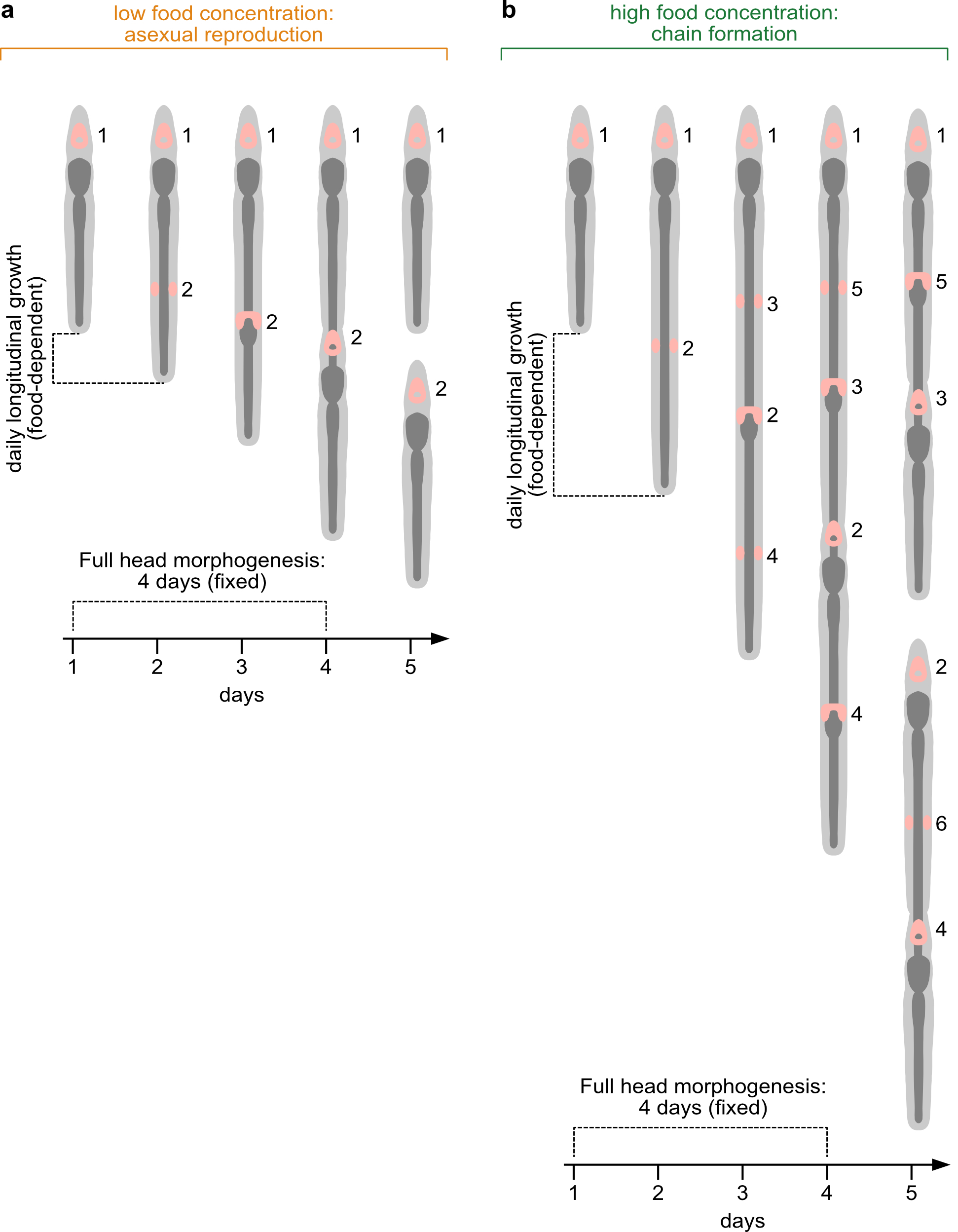
In the new experiments, abundant food altered the timing of reproduction. The worms grew so quickly that another reproductive cycle began before the previous one was complete.
Several developing clone sections consequently remained attached, forming a temporary chain with multiple heads.
“We suspected from the beginning that the food could be responsible for triggering chain formation,” University of Warsaw zoologist Ludwik Gąsiorowski told ScienceAlert.
“However, I personally was expecting that rather food quality (i.e., prey species) and not food quantity would trigger the process.”
The team initially offered seven kinds of microscopic prey to sixStenostomumspecies.
Four species consistently grew and reproduced when fed a single-celled freshwater organism containing green algae.
The researchers then varied the amount of this prey, and chain formation increased markedly as more food became available.

“What surprised me the most is how reliable and reproducible this effect is,” Gąsiorowski said.
“If we want to obtain worms in chains, it’s just enough to put them in a known high concentration of specific prey for three days, and we will always see the chains.”
As the worms swallowed the green prey cells, their digestive systems turned vivid green and their bodies rapidly lengthened.
“Within roughly two days, the first of the new heads becomes visible,” Gąsiorowski explained.
At first, the developing head appears as two transparent spots in the middle of the worm as the forming brain pushes the darker gut tissue inward.
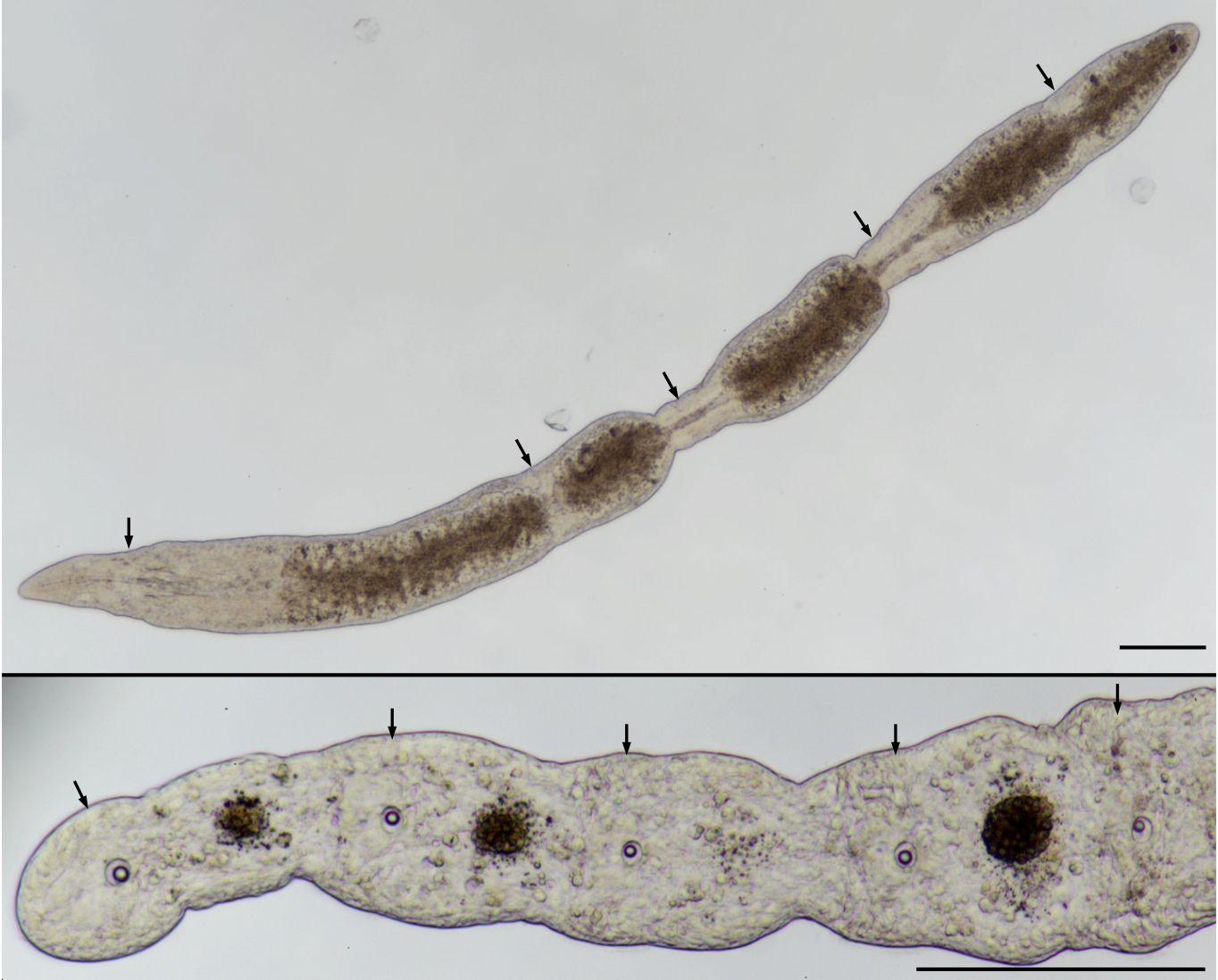
Additional heads then begin to emerge along the lengthening body, which you can see in the image below.
Around four days after feeding begins, the longest chains contain four or five zooids, connected tail-to-head.
The chains are not permanent. Once the oldest developing head is complete, the worms separate into smaller chains or independent individuals. If food remains abundant, they grow, form chains, and divide again.

Extra food accelerates the worm’s lengthwise growth, but a new head still takes around four days to form – so the worm becomes large enough to begin another reproductive cycle before finishing the first.
The researchers call these chain-like structures “paracolonies” because they resemble animals that form clonal colonies, but eventually break apart.
The team also tested whether remaining in a chain gave the worms any immediate advantage. They found no evidence that the connected sections shared the work of digestion.
However, chains of oneStenostomumspecies were less likely than solitary worms to be selected by a predator in the experiments, though not in another species.
That’s not necessarily because theStenostomumchains had more brain power to somehow outwit predators.
Gąsiorowski noted that even if an advantage exists, it may result from increased body size (and therefore moreciliato propel worms through water) rather than the presence of multiple connected heads.
“We still know very little about the ecology of these microscopic invertebrates – we don’t even know what their main predators are in the natural environment, which limits our capacity for testing some ecological mechanisms,” he said.
“Even if the worms are selected for the ability to increase their body size, the formation of chains remains an accidental developmental byproduct.”
While it’s only a temporary phase forStenostomum, some related flatworms are known to form permanent chains, which suggests they might find such a form useful.
, for instance, can produce chains containing more than 15 connected sections, while another related flatworm species has been observed with as many as 50.
But Gąsiorowski’s team has been unable to keepC. lemnaealive in the lab, so they don’t know whetherC. lemnae‘s reproductive strategy is a more established version ofStenostomum‘s food-induced chains.
“We cannot directly test if alternation between asexual reproduction and chain formation follows similar logic as inStenostomum,” Gąsiorowski said, although given how closely related they are, “it seems plausible that chains inCatenulaevolved from conditions similar to what we observe forStenostomum.”
If we know so little about the watery worlds these worms inhabit, then for now, those remain curious questions to consider.
The study is available on thebioRxiv preprint server.
This article was fact-checked byRachel Garnerand edited byClare Watson. While we pride ourselves on our process, we are only human. If you spot a mistake, [[LINK_10: please let us know]].
Kaynak: Doi