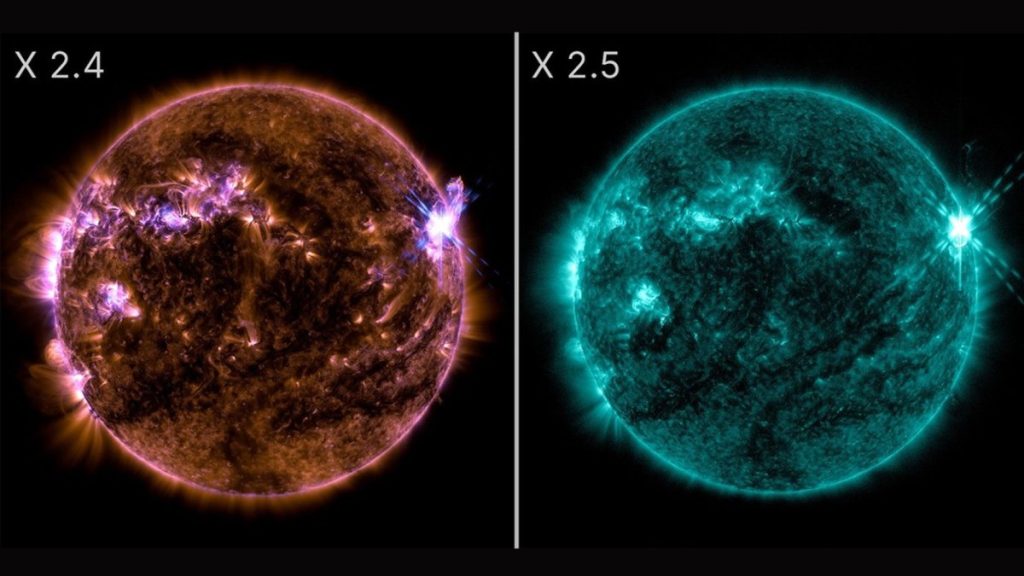
Thesunis an incomprehensibly gigantic,constantly roiling nuclear furnace-but some days are even busier than others. Based on data collected by NASA’sSolar Dynamics Observatory, our solar system’s central star recently fired off not one, but twoimpressive X-class flareswithin hours of each other. The sun emitted an initial X2.4 solar flare at 9:07 p.m. EDT on April 23, followed by an X2.5 sibling of extremely hot, charged energy at 4:13 a.m. EDT the next morning. But while the X-class designation signifies the most intense tier of events, the latest pair pale in comparison to some of the most powerful on record.
Solar flaresare as inevitable as they are powerful. While the sun’s baseline may seem chaotic to us, astronomers know that the yellow star follows a relatively predictable, 11-year cycle of electromagnetic fluctuation. These timelines switch between apex and nadir phases known as the solar maximum and minimum. In October 2024, NASA and the National Oceanic and Atmospheric Administration’s (NOAA) Space Weather Prediction Center confirmed that the sun had entered its most recent, roughlyyear-long solar maximum. Although it’s now firmly out of that phase, the sun still produces regular flares across its surface.
How solar activity affects Earth depends on a range of factors, including an emission’s strength and its direction. Direct encounters can affect the planet’s magnetosphere, generatingcolorful auroras, while also disrupting radio communication, GPS, satellite operations, and energy grids. Other times, we may barely even notice when a flare happens.
Flare strength is classified in ascending tiers, with each subsequent level denoting at least a tenfold increase in power. A-class events are the weakest, followed by the B, C, M, and X-class.
Although the recent X2.4 and X2.5 flares were strong enough to cause temporary radio blackouts over portions of the Pacific Ocean, Australia, and East Asia, they don’t even rank in the top 50 strongest examples on record. Themost powerful solar flare ever observedtook place on November 4, 2003. The massive flare was rated at least X40, if not higher. The associated coronal mass ejection erupted into space at a speed of over 2.6 million miles per hour, causing massive energy grid and communications disruptions.
Kaynak: Popular Science