byUniversity of Wisconsin-Madison
This article has been reviewed according to Science X’s
editorial process
andpolicies.
Editorshave highlighted
the following attributes while ensuring the content’s credibility:
fact-checked
trusted source
proofread
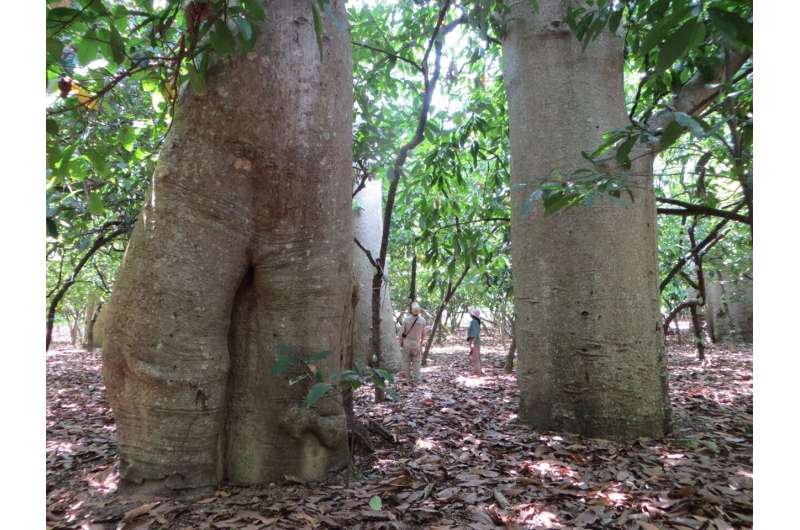
Madison researchers recognize a new species of baobab tree, Adansonia bozy, unique to Madagascar,according to a studypublished in the journalTaxon. Previously, members of A. bozy were classified within a different species of Malagasy baobab, Adansonia za.
While the species look similar, careful genetic analysis revealed that the northern populations of A. za are more closely related to other northern Malagasy baobab species. This discovery could have implications for conservation efforts for the endangered trees.
Baobabs are charismatic trees that grow in Australia, continental Africa and Madagascar. Before this paper, there were eight recognized species of baobabs: one in Australia, one in continental Africa and six in Madagascar.
“It’s surprising that we’re still answering basic biological questions about baobabs, in terms of how many species actually exist on the landscape,” says lead author Nisa Karimi, who worked on the project for her Ph.D. in the former Department of Botany.
She collaborated with UW-Madison co-author David Baum and researchers from the Missouri Botanical Garden and Iowa State University. Baum, who has been studying baobabs for more than 40 years, explains that while the threshold for defining a new plant species is complicated, in the case of A. bozy, the genetic data they collected made it crystal clear.
“Any group that we choose to recognize in a taxonomy should be composed of organisms that are more closely related to each other than to anything outside the group,” says Baum.
To collect the tissue samples necessary to analyze the baobab’s genetics, Karimi had to navigate to remote parts of Madagascar and locate the trees. Since some species of baobabs in Madagascar can look similar, Karimi says it’s sometimes impossible to identify the species by looking at its leaves alone.
“To know what you’re looking at, you have to see them in flower,” Karimi says.
But that’s easier said than done. Each species flowers for about one month, and the blooms only open after dusk-way up in the branches, sometimes more than 100 feet above the ground (30 meters). Timing is crucial, as is training to use the complicated climbing rig required to scale the massive trunks and rappel back down.
After collecting leaf samples, Karimi brought them back to Wisconsin to be ground up for extraction. Since the tissues were rich in polysaccharides, grinding them produced a very slimy substrate.

“If you’re trying to get long genetic sequences, you need high-quality DNA,” Karimi says. “But, oftentimes, when you have this sort of slimy tissue, [the DNA] fragments.”
It took a lot of trial and error, but Karimi worked out a way to get the high-quality strands of DNA they needed. Then, they used the gold standard of phylogenetic analysis, a method called targeted sequence capture, which identifies and sequences hundreds of genes of interest from an organism.
Karimi first looked at the fragments of DNA from one organism, identifying which parts of the strands coded for the genes they were interested in tracking. Once that was done for every organism sampled, she could compare the genes across species. Karimi also used computational methods to summarize and integrate the hundreds of gene sequences she was analyzing across species.
“Despite sharing morphological traits with the species with which it was later classified, [A. bozy] is actually more closely related to two other groups in northern Madagascar than the species it was synonymized with,” Karimi summarizes.
Based on its known distribution across Madagascar, Karimi and Baum also believe the new species is endangered.
Since funding for conservation efforts in Madagascar often prioritizes threatened and endangered species, Karimi says there may be more funds available to help A. bozy. Their findings also raise questions about the conservation of A. za, which was once thought to be widespread.
Now, with the “loss” of A. bozy individuals, A. za is a smaller species, which may also prompt a reclassification of its conservation status.
“You can’t conserve anything if you don’t know how to describe and name them and understand how they’re related to other things on the landscape,” says Karimi.
She and Baum believe there may be additional species waiting to be discovered in remote areas of Madagascar. Indeed, their results suggest thatanother widespread species, A. rubropstipa, may also need to be divided. They plan to continue researching baobabs in Madagascar to improve our understanding of the island’s rich biodiversity and ways to improve its conservation.
More information
Nisa Karimi et al, Phylogenomic analysis of Madagascar’s baobabs reveals admixed populations and supports resurrection of a previously described species,TAXON(2026).DOI: 10.1002/tax.70176
Key concepts
Provided by
University of Wisconsin-Madison
MA in English, copy editor since 2021 with experience in higher education and health content. Dedicated to trustworthy science news.
Full profile →
PhD nano-engineering from Delft University. Published researcher and journal reviewer. Brings scientific insight to content standards.
Full profile →
Genetic analysis reveals new species of endangered baobab tree in Madagascar (2026, August 14)
retrieved 14 August 2026
from https://phys.org/news/2026-08-genetic-analysis-reveals-species-endangered.html
part may be reproduced without the written permission. The content is provided for information purposes only.
Kaynak: Wisc